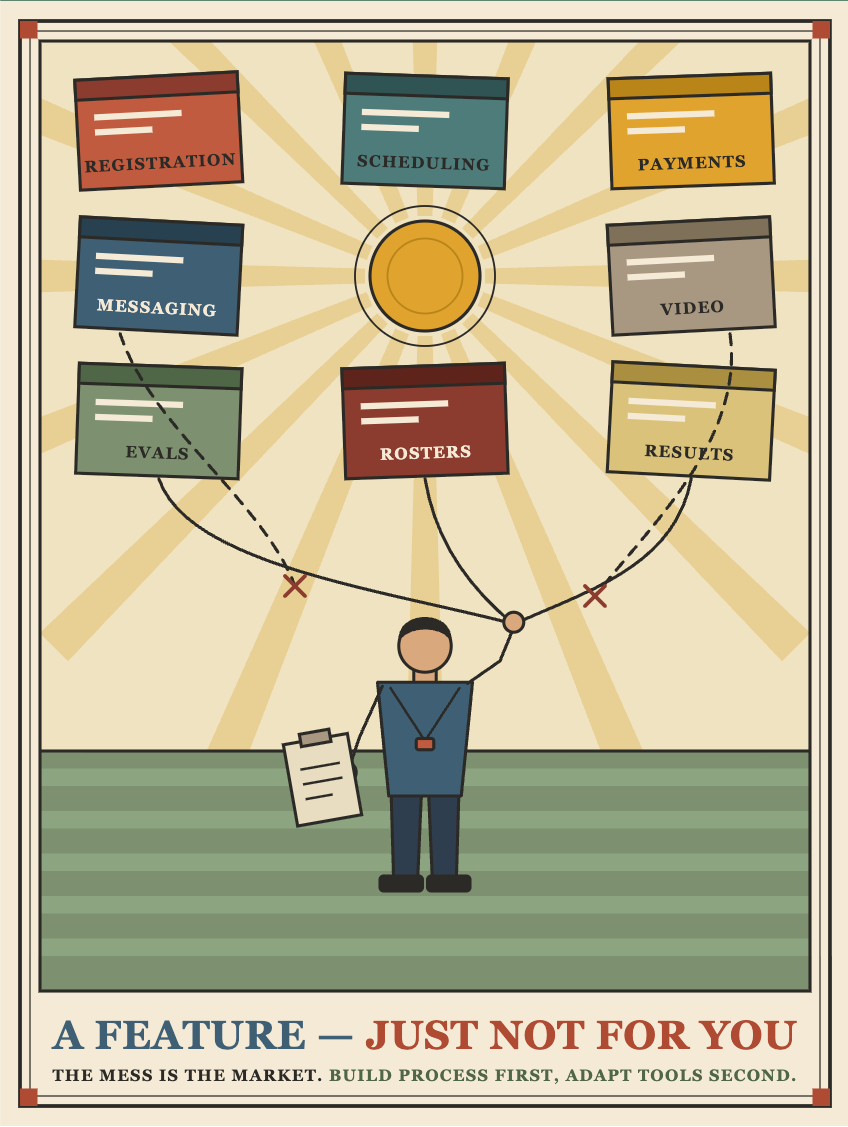
There is recent hype in youth sports that the magic lives in the uniforms, the content videos, the sponsorship banners, or the five-year growth forecast. It doesn’t.
Sports begin with a date, a time, a patch of land, and an agreement.
That’s it.
This spring, in a moment of either courage or temporary insanity, I took the reins as the
Firehawks Lacrosse club scheduler. I have seen things.
Scheduling, at its core, is what makes sports happen. Not the logo. Not the video package set to dramatic music. Not the board meeting where we discuss “vision.” A field.
A clock. Two teams. If you can coordinate those, you have a game.
You can still do it with pencil and paper. For decades we did. Now we have software platforms, shared calendars, automated notifications, and enough color-coded grids to make a NASA engineer sweat. AI is circling the space and will likely take scheduling software’s lunch money soon enough. Fine. Even when our robot overlords arrive, I’m confident we’ll still be able to agree on 4:00 PM at the park for lacrosse—assuming we’re not occupied negotiating with Skynet.
But because
scheduling is the sport, the act of building it is intense.
It comes in violent bursts. Registration closes and suddenly every coach has a constraint, every parent has a preference, and every referee has a wedding. There are blackout dates, field closures, tournament conflicts, competitive balance concerns, sibling overlaps, weather threats, and that one team that cannot play before noon but also cannot play after 3 PM.
It is a puzzle where the pieces occasionally light themselves on fire.
After a season in the chair, here’s my advice:
Fill the voids. Where there is silence, negativity moves in and redecorates. Communicate early. Communicate often. Communicate when you think you’ve over-communicated. If people don’t know what’s happening, they will invent something worse.
Accept that you will disappoint everyone.
If no one is ecstatic, you’re probably being fair.
Follow the rules - your league parameters, your field inventory, your timelines. Own the decisions. Don’t blame “the system.” You are the system.
You will receive very few thank-yous. But you will know what it took to turn chaos into a calendar.
And those who know, know.
Because without the schedule, there is no sport.
The schedule is the sport.