This spring and summer, I met with a lot of founders in youth sports.
New platforms. New layers. New AI assistants. New all-in-ones that do everything, and one more thing. Some of it was genuinely good. Some of it felt like a ten-pound solution to a two-ounce problem.
Software has never been cheaper to build, and youth sports is riding the same wave, and likely heading for the same correction, that education went through several years ago. It isn't producing fewer problems. It's producing more tools built to solve them, as entrepreneurs flood the space with the same promise: we'll simplify your life.
So ask yourself: does your life feel simpler? How many vendors have you talked to this year that may not be here next season?
Everyone in this ecosystem - builders, operators, directors, volunteers, investors - is asking some version of the same question. Is the flood of platforms helping operators, or drowning them? Is fragmentation a feature or a bug?
It's both. Which one depends entirely on who's paying.
Who fragmentation is for
For operators and parents, it's a bug. You pay in passwords reset every year, information scattered across five systems, and hours spent reconciling data.
For builders and investors, it's a feature. Every new platform means more subscriptions, transaction fees, services, and reasons for families to pay. When the ecosystem gets complicated enough, another layer appears to connect or manage it. Yes, that includes companies like ours.
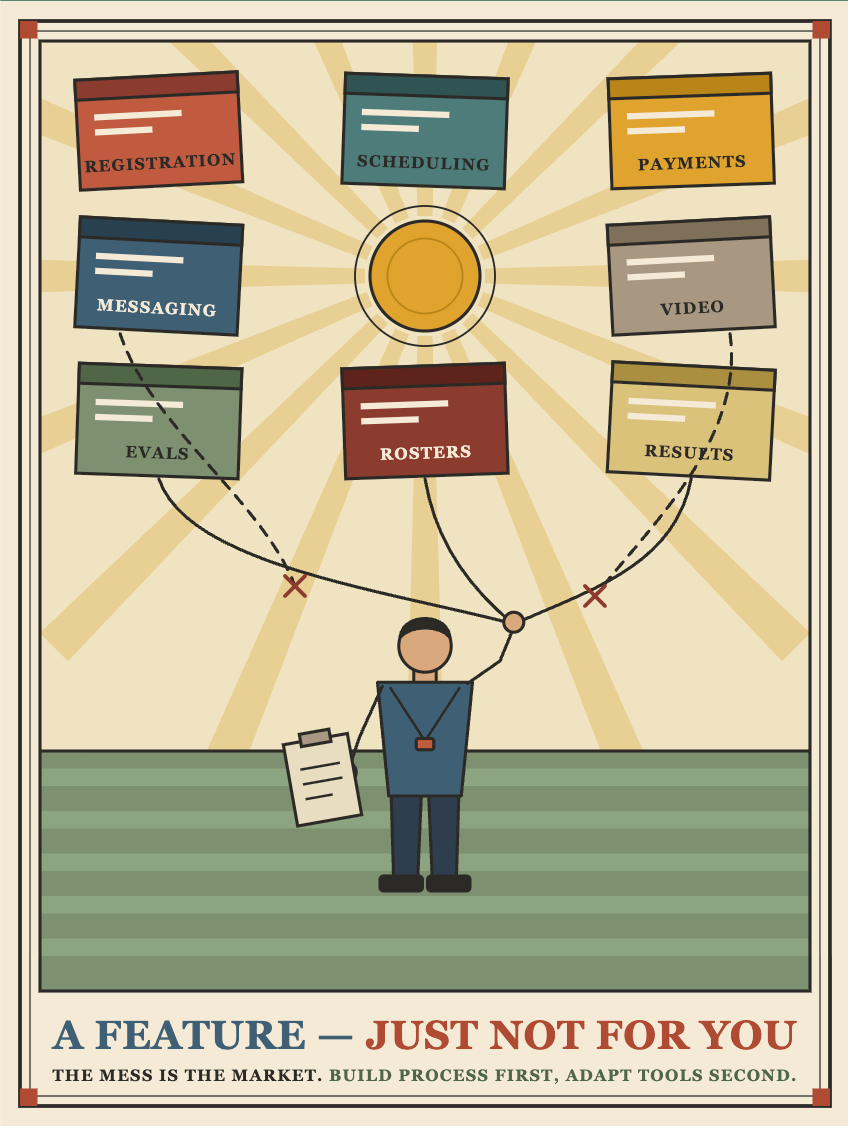
The mess isn't a failure of the market. In many ways, the mess is the market.
Consider the features operators are sold: practice-plan libraries, player-development trackers, video tools, evaluation systems. Now count how many parents actually use them. Parents mostly need three things - registration, a schedule, and directions to the field. Kids need even less. The
Aspen Institute's 2026 national survey found that kids' leading motivations were having fun and spending time with friends, not using another feature on a platform.
But platforms aren't sold to kids or parents. They're sold to operators. And operators buy features to do the work and to distinguish themselves from the club down the road. So a feature can succeed commercially even when almost no family touches it. It was built because it could be sold, which is different from being built because it was needed.
The all-in-one doesn't replace the stack. It joins it.
The all-in-ones promise the exit: one system replacing the ten you use now. But ecosystems rarely switch completely. One league keeps its old registration system. A coach prefers another communication app. Parents already know the previous platform. The new all-in-one doesn't replace the stack, often times it joins it.
Consolidation at the top doesn't fix it either.
LeagueApps has acquired NCSI, not long after parent company
Accel-KKR acquired Arbiter.
PlayMetrics has acquired SportsEngine after
combining with Crossbar and Stack Sports.
Fastbreak has added hotel and housing capabilities to an already broad offering.
That's consolidation of ownership. It is not yet consolidation of logins. When companies combine, operators often get one financial owner with more control over their operation, not one seamless system. Pricing power consolidates faster than technology does.
So: feature or bug? It's a feature, just not primarily for you, the operator. New tools keep launching at the bottom, the giants keep buying each other at the top, and neither trend is aimed at making your life simpler. The market incentive points the other way.
Which means your job isn't to wait for the market to get simpler. Nobody else has that incentive.
The field, sorted
Almost every company in this space is making one of two bets: that youth sports consolidate onto a few major platforms, or that fragmentation is permanent and the winning tools will connect what already exists. Knowing which bet a vendor is making tells you a lot about what you're actually buying.
Own the platform.
LeagueApps,
PlayMetrics, and
Fastbreak.ai are among the leaders betting on consolidation; one system running as much of the organization as possible. The upside is real: fewer vendors, fewer bills, potentially one source of truth. The tradeoff is control. Leaving later is usually harder than the sales demo suggests.
The newer all-in-ones. Below the giants is a growing group with compelling technology and user experience.
Sprocket is focused on mid-sized clubs and financial visibility.
Byga brings soccer-specific depth and is expanding into volleyball.
Praxis offers an end-to-end platform and has been selected by the United Soccer League. AI-native entrants like
GoHurdle and
TeamLinkt are building from a newer foundation.
Each presents itself as the cure for fragmentation - their home pages read like this post. But a better interface doesn't reduce the number of systems you run. Unless you actually retire the old tools, the new platform is one more.
"Free" deserves the same scrutiny. If registration or team management costs nothing, revenue is coming from somewhere: transactions, apparel, advertising, premium services, data. Free is a pricing strategy, not a gift, and whatever funds the product eventually shapes what it optimizes for.
Climbing from the gear up.
SecondSlide grew a platform around the gear, then added registration as it learned what clients needed.
Signature Athletics is the same climb at scale - a roll-up of gear, programs, media, and growth services into a single youth sports "ecosystem," now raising public money on the concept. What they've built is impressive. But notice who the "everything" pitch is aimed at. The all-in-one story sells to investors even better than it sells to operators.
Connect what you already have.
SPiN and
Onsides are amongst those that bet the other way - that fragmentation is permanent. Rather than replacing platforms, they connect the systems families and organizations already use. SPiN is building a network and identity layer across the ecosystem; Onsides pulls a family's sports information into a single view. (For what it's worth, I use Onsides and find it helpful.) The risk for any connector is dependency: its usefulness rests on continued access to platforms it doesn't own. Ask how those connections work, and how secure they are.
Layer on top.
A fourth category solves one defined problem on top of data you already have.
Retain Players identifies where athletes are leaving.
Bravara focuses on evaluations and team formation. They don't promise to run your organization. That may be their greatest strength.
So, now what?
More tools are coming. The market is built to guarantee it. The measure that matters isn't features, it's whether the tool taming your admin glut can be switched off. The more a fix depends on you handing over control, or on the cooperation of platforms it doesn't own, the more loosely you should hold it. Own the pieces you can't afford to lose.
And the way out isn't a tool. It's process.
Build your own operating process first, rather than outsourcing it to a platform whose processes are already encoded in the app. Then decide where you get the competence to run it: buy it inside an all-in-one, build it minimally (one of our more sophisticated clients has left youth sports platforms entirely - Square plus a stack of AI tools), or rent it from a person.
The criterion isn't features or tech. It's what takes the least of your attention. Every hour spent running the tool is an hour you're not coaching or directing.
Stay curious about what’s out there, just stay clear-eyed while you’re doing it.
All the best-
Tyler